




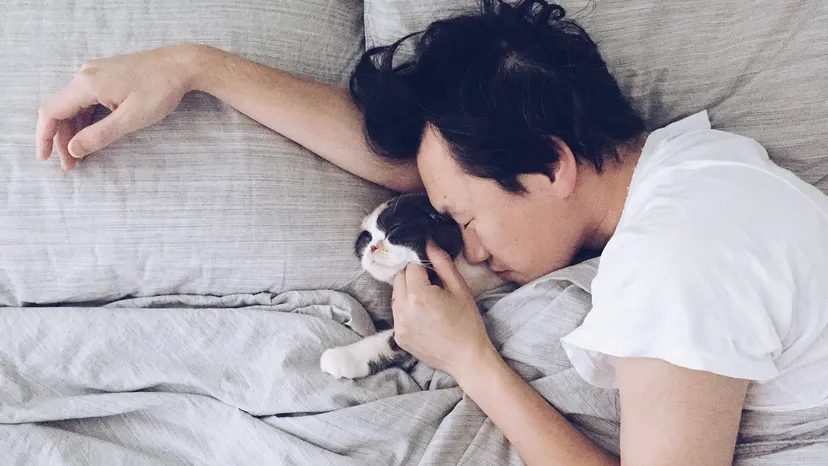
If you treat your days off like a recharge station rather than just another slot in the calendar, you might be onto something. A Swedish study suggests that catching up on sleep after a grind-heavy week is more beneficial than experts previously thought.
The research, published in April 2018 in the Journal of Sleep Research, challenges the old advice that you must wake up at the exact same time every single day. It posits that compensatory sleep—those extra hours on weekends—may actually protect against early mortality.
The Scale of the Investigation
This wasn’t a small pilot program. The researchers analyzed data from over 43,000 participants in the Swedish National March Cohort. The cohort tracking began in 1997.
Follow-up continued for each subject until they died, moved away, or the study officially closed on December 31, 2010.
To get their numbers, the team pulled self-reported data on basic sleep habits. They asked two distinct questions:
* How many hours do you sleep on a workday night?
* How many hours do you sleep on days off?
Response options ranged from less than five hours to greater than nine hours. This granularity allowed them to spot differences that broader studies often miss.
The Weekend Exception to the Mortality Rule
Previous research established a clear pattern regarding sleep and death. Consistently sleeping too little (defined as five hours or fewer) or too much (nine hours or more) correlates with higher mortality rates. The sweet spot is generally considered to be in the middle.
But here is the catch. Most studies ask participants to report a “typical” night of sleep. Because there are five weekdays and only two weekend days, that self-report heavily skews toward weekday habits. It ignores the reality that many people sleep significantly longer on their days off.
“Weekend sleep duration” became the variable that changed the narrative.
When researchers isolated the data, they found that the mortality risk remained high for people who were short sleepers on both weekdays and weekends. The risk also stayed elevated for those who slept too much every night.
However, a different pattern emerged for those who slept short hours during the week but extended their sleep on weekends.
“When weekend sleep is extended after short weekday sleep no association with mortality is seen,” the authors wrote. “We suggest that this may reflect positive effects of compensatory sleep.”
In plain terms: If you are a short sleeper during the work week, catching up on weekends appears to neutralize the increased risk of death associated with that sleep deprivation.
Why This Matters for Your Circadian Rhythm
Sleep experts have long preached gospel about consistency. The prevailing theory is that yo-yoing between sleeping in on Saturdays and waking up at dawn on Mondays disrupts your circadian rhythm. That disruption can lead to poor sleep quality and long-term health issues.
This new data complicates that advice. It suggests that for some people, the biological benefits of recovery sleep outweigh the disruption to their internal clock.
Of course, correlation is not causation. The study authors acknowledge that more research is needed.
“The real question is whether there is, in fact, a build-up of deficit, or biological changes that are gradual over time, even though you get recovery sleep,” Dr. David Dinges told Time. He was not involved in the Swedish study but works in sleep and chronobiology at the University of Pennsylvania Perelman School of Medicine.
Does the debt clear out completely? Or are there subtle, gradual changes happening that catch up with you later? The study doesn’t answer that. It just shows that, in this large dataset, people who slept in on weekends didn’t die earlier than their peers who maintained steady sleep habits.
The Lifestyle Factors Behind the Numbers
The researchers also dug into the lifestyle profiles of these sleepers. The results were interesting and somewhat counterintuitive.
People who consistently logged long hours of sleep were:
* Less likely to use sleep medications
* Lighter coffee drinkers
* Never smokers
Conversely, habitual short sleepers tended to be:
* More physically active
* Older
* Less educated
These factors complicate the picture. Short sleepers were more active, which is generally good for health. Yet they still had higher mortality rates when they didn’t make up for it on weekends. Long sleepers had healthier habits overall (no smoking, less caffeine), which might explain why their long sleep duration didn’t carry the same mortality penalty as it does in other studies.
The Bottom Line
You don’t have to choose between strict circadian discipline and total exhaustion. The data suggests that if your work week forces you into a sleep deficit, allowing yourself to recover on weekends is not just a luxury. It might be a survival strategy.
Of course, this is observational data. It doesn’t prove that sleeping in causes longer life. But it does show that people who do it aren’t paying a price in mortality, unlike those who stay short on sleep seven days a week.
So, can you finally justify hitting the snooze button? The evidence says you probably can. The science