




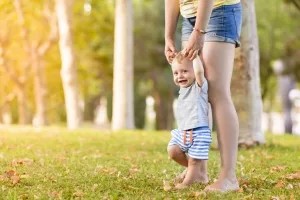
You look down at those tiny, squishy feet and feel a surge of protectiveness. They look fragile. They look like they need armor against the world. So you buy the softest, cutest little sneakers you can find. You wrap them up. You think you are being a good parent.
Experts say you are likely doing more harm than good. Barefoot walking in childhood isn’t just a trend for minimalist parents. It is a biological necessity. The foot is not just a support structure. It is a sensory organ, a muscle builder, and a balance system. When you encase it in synthetic material before it is ready, you interfere with how it learns to move.
How bare feet build stronger muscles and better balance
Your child’s first steps are clumsy. That is normal. But the clumsiness is part of the training. When a baby walks barefoot, the toes splay out. They grip the ground. The arch develops through use, not through support.
A shoe with a stiff sole prevents this. It stops the foot from feeling the ground. The brain doesn’t get the feedback it needs to stabilize the ankle and knee.
“The foot is a complex system of 26 bones, 33 joints, and over 100 muscles and ligaments. It needs stimulation to develop properly.”
Consider the difference between a child on grass and a child on carpet in thick shoes. The barefoot child uses their core muscles to maintain balance. The shod child relies on the shoe’s structure. Remove the structure, and they fall. Keep it, and their core stays weak.
Why rigid soles can cause long-term foot problems
Many parents worry about sharp objects on the sidewalk. They fear glass. They fear rocks. So they buy shoes with heavy soles for protection. This is a common misconception.
A healthy adult foot is tough. A developing child’s foot is sensitive, yes, but also adaptable. The real danger is not the rock. It is the shoe that prevents the foot from doing its job.
Rigid soles can lead to:
– Weak arches
– Poor toe grip
– Increased risk of tripping
– Delayed motor skill development
You do not need to keep your child in a sterile, padded box. You need to let them feel the world.
Which shoes to avoid when buying for toddlers
If you must buy shoes, know what to reject. The market is full of marketing gimmicks that hurt more than help.
- Avoid “memory foam” insoles. They cushion the foot from feeling the ground. This is bad for development.
- Skip stiff-soled shoes. If you can’t bend the shoe in half easily, it is too rigid.
- Don’t buy shoes just for decoration. Flashy colors don’t help the foot. Fit does.
- Ignore “orthopedic” claims for toddlers. A toddler’s foot is not an adult foot. It doesn’t need adult-style support.
The best shoe for a toddler is the thinnest, most flexible one that offers basic protection from extreme hazards. But the best “shoe” is no shoe.
Where barefoot walking is safe and practical
You don’t need to live in a forest. You just need
Bare Feet: Why Shoes Actually Hinder Early Walking
Babies arrive with feet that act like hands. Evolution left them shaped for gripping and climbing, similar to our primate relatives in the trees. To become upright bipeds, the infant must transition from this grasping state to standing. This shift, which took millions of years for the species to develop, typically takes an individual child only ten to fifteen months.
Surprisingly, footwear is not part of this process. Experts from the Stiftung Kindergesundheit are adamant: shoes are not needed for learning to walk.
“No matter how delicate they appear – baby feet are strong enough to support the body weight,” says pediatrician Berthold Koletzko, chair of the foundation. “For healthy development, shoes are not required. In fact, the opposite is true: they prevent the child from receiving important sensory stimuli and sensations.”
Koletzko advises against the popular “first walkers” or learning shoes often found in stores. The human foot only needs protection against cold, heat, and injury. It does not need a shoe to learn balance or gait.
How Barefoot Walking Builds Muscle and Balance
The ideal environment for the first steps is barefoot. If the floor at home is too cold, socks with rubber grips on the soles are a suitable alternative. They allow the feet to move freely and make it easy to check if they fit properly. Flexible slippers are another option, provided they are not too short. Recent studies show that in 80 percent of cases, indoor footwear is too small.
The benefits of walking on your own soles are physical and sensory. Koletzko notes that a child opens up a new world when barefoot. For the first time, they feel sand, grass, gravel, warm soil, and wet ground.
Walking over uneven surfaces does more than just entertain. It:
– Strengthens the leg muscles
– Stabilizes the bone structure
– Trains the sense of balance
– Makes the walking style more secure
This natural training is essential. A constrained foot cannot learn these dynamics effectively.
Why Insoles and Stiff Shoes Are Counterproductive
About 98 percent of babies are born with healthy feet. By adulthood, however, roughly 60 percent of people have developed foot or posture problems. In more than half of these cases, the damage started in childhood.
For decades, the standard remedy was insoles and firm, high-laced boots. Koletzko argues this was exactly the wrong approach.
“We know today that such aids do not promote a healthy child’s foot; they actually hinder it,” he explains. “Children’s shoes must be soft and flexible. They must never squeeze the foot. The foot should not adapt to the shoe; the shoe must adapt to the foot.”
Rigid structures restrict the natural movement required for development. The foot is a complex organ of 26 bones and 33 joints. It needs room to move.
The Shift from Too Small to Too Large
Historically, data on children’s actual footwear showed a consistent problem: half of children in Germany wore shoes that were too small. Parents often tried to save money by stretching a pair of shoes over a growing foot for as long as possible.
The latest “German Children’s Foot Report” revealed a surprising reversal. Today, many children wear shoes that are too big.
- Over 40 percent of children wear shoes that are one to three sizes larger than their actual foot measurement.
Why the change? The Stiftung Kindergesundheit suggests the high cost of good children’s shoes is a major factor. Parents are now trying to save a shoe size, rather than a shoe purchase. They buy a larger size to make the pair last longer.
This trend is harmful. A shoe that is too large does not protect the foot. It prevents proper grip and balance. The child must use extra energy to hold the foot in place, which can disrupt the natural learning process of walking. The fit must be precise. Not too tight. Not too loose. Just right.