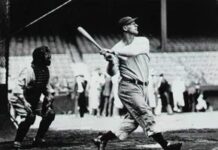




The 1919 Boston Red Sox were a mess. Bad baseball, worse finances. Owner Harry Frazee was broke, and two men from across the street in New York smelled blood in the water. Jacob Ruppert and Tillinghast Huston wanted the one thing that could save their franchise: George Herman Ruth.
Both men went by “Colonel,” but that was about the only thing they shared.
The Two Colonels
Tillinghast Huston was the real deal. He grew up modest in Ohio, fought in Cuba during the Spanish-American War, and made his money engineering harbor projects in Havana. He stayed a casual guy, often wearing the same suit for days. The ballplayers called him “Cap” out of respect for his military rank. He was big, heavy-set, and a drinking buddy of Frazee’s. Their offices were literally two doors apart in New York.
Ruth later guessed in his autobiography that the whole deal started with Cap and Harry over a few glasses of beer.
Jacob Ruppert was different. Money was in his blood. His grandfather started a brewery in Bavaria; his father made millions in the states. Ruppert was a 51-year-old bachelor who wore the finest suits and had a staff of servants at his Fifth Avenue apartment. He was a former congressman and a self-promoter who insisted on being called “Colonel” after a political crony gave him the honorary title. He collected art, racehorses, and ballplayers.
Ruppert had been circling Ruth for a while. He reportedly tried to buy him back in 1918 after watching Babe hit a home run at the Polo Grounds.
The Pitch to Get Ruth
The urgency came from the field. Yankees manager Miller Huggins was a 5’6″, 135-pound sparkplug who had taken the Yanks to third and fourth place since leaving the St. Louis Cardinals. After the disastrous 1919 season, Ruppert asked Huggins what the team needed.
Huggins didn’t beat around the bush.
“Get Ruth from Boston.”
Huggins knew Frazee needed cash. He went to Boston to check the price. Frazee would “start talking” at $125,000. Ruppert thought that was crazy. Huggins had a simpler answer: “Bring him to the Polo Grounds and he’ll hit 35 homers at least.”
By late December, an offer was on the table. Ruth for cash only. No players. Frazee wanted quick money. He also didn’t want to clutter his roster with weak replacements. Manager George Barrow told him, “Losing Babe Ruth is bad enough. But don’t make it tougher for me by making me show off a lot of 10-cent ballplayers that we got in exchange for him.”
The Yankees had their own fears. Ruppert’s income relied on his brewery, and Prohibition was weeks away. If Ruth arrived and Yankees attendance spiked, Giants manager John McGraw might force them out of the Polo Grounds. Building a new park would cost millions.
They did it anyway.
The $400,000 Deal
On December 26, 1919, the deal was struck in secret.
- $25,000 cash upfront
- Three $25,000 promissory notes
- A $300,000 loan against the Fenway Park mortgage
Total: $400,000.
That was nearly what Ruppert and Huston had paid for the entire Yankees franchise four years earlier. The $100,000 in cash alone doubled the $50,000 the Indians paid for Tris Speaker in 1916. It was the most ever paid for a ballplayer.
The public had no clue. Not until Frazee told reporters the next day that he was open to offers for every Red Sox player except one: Harry Hooper.
Meeting the New Star
Huggins flew to Los Angeles to tell Ruth. They met on the Griffith Park golf course. Huggins introduced himself, shook hands, and made small talk.
Ruth suspected it already.
“I’m happy with the Red Sox,” Babe said. “I like Boston. But if Frazee sends me to the Yankees, I’ll play as hard for them as I did for him.”
The Red Sox didn’t just lose a player. They lost their soul. And the Yankees? They just bought the future.
The Contract: Cash and Conduct
Huggins didn’t beat around the bush. He told Ruth that his wild days in Boston were over. In New York, he had to be strictly business. The manager laid out the temptations of the Big Apple and warned that no player on his roster would succumb to them.
Ruth, who generally preferred a good time to a lecture, tuned out after a minute. He cut through the moralizing with a simple counter-offer: “I already told you I’ll play the best I can. Let’s get down to business. How much are you going to pay me?”
Ruppert had given Huggins specific instructions. The initial offer sat at $15,000, then jumped to $17,500 per year. Ruth held his ground at $20,000 and added another layer: he wanted a piece of the profit Frazee had made on the sale.
Huggins ran the numbers back to Ruppert. The final agreement was a two-year deal. Ruth would receive his 1919 base salary of $10,000 for each season. On top of that, he got an immediate $1,000 bonus. The rest came in $2,500 installments over the two years, totaling an extra $20,000. That put his annual take at $20,500. He was paid more than Ty Cobb. And he supposedly promised to behave.
Why Frazee Blamed Ruth for Boston’s Decline
Harry Frazee made the sale public on a Monday afternoon, January 5, 1920. He called a press conference and refused to name the exact price, calling it “enormous.” He claimed no other club could afford to refuse the offer. He said he preferred a player swap, but no team would give up equivalent talent without wrecking their own roster, so cash was the only way.
Frazee didn’t mince words about his former star. He called Ruth “one of the most selfish and inconsiderate men ever to put on a baseball uniform.” Then he did the unthinkable: he blamed Babe for Boston’s poor performance the previous season.
“You will notice that a one-man team is almost invariably in the second division… The other players have little incentive or encouragement for great effort when the spectators can see only one man in the game, and so the one man has an upsetting influence on the others.”
That was a strange thing to say about a guy hitting out of the park. Frazee was essentially arguing that Ruth’s greatness was hurting the team. He went on to criticize Ruth’s greed and his “insubordination,” claiming it endangered the discipline of the squad.
How Fans Reacted to the Ruth Trade
Boston fans were not buying Frazee’s promise to reinvest the money. They had watched their perennial champions get dismantled by a smooth-talking owner for years. The reaction was immediate and negative.
The Boston Post called the move “a tremendous blow to the army of loyal fans.” They predicted the Red Sox would be crowding the Athletics for eighth place in 1920. Another paper ran a cartoon showing Faneuil Hall and the Boston Public Library with “For Sale” signs hanging from them. The artist clearly didn’t think any local landmark was safe with Frazee in town.
Johnny Keenan, leader of the “Royal Rooters” fan club, said it plainly: “Ruth was 90 percent of our club last summer… It will be impossible to replace the strength Ruth gave the Sox.”
A Knights of Columbus chapter in South Boston passed a resolution stating that fans were “dealt unfairly” and that “commercialism is fast gaining control over baseball.” One fan, seeing a poster for Frazee’s current show, My Lady Friends, near Fenway Park, made a comment that stuck: “Those are the only friends that blankety-blank has.”
Why New York Fans Were Excited About Ruth
Yankees fans saw it differently. The Polo Grounds had a right field foul line that stood just 257 feet from home plate. Ruth was a notorious pull hitter. He had already hit five of his first 11 big league home runs in that park. Huggins predicted 35 homers for the season. That seemed like a reasonable estimate.
New York sportswriters gathered to toast the city’s new asset. The New York Times, however, took a colder view. An editorial under the headline “The High Price of Home Runs” compared Ruth’s salary to that of a Columbia University professor. The paper suggested it was a poor state of affairs when a good player on a weak team could hold out for an imposing salary and get a buyer in New York or Chicago.
Did Babe Ruth Protest the Trade?
Amidst the noise, rumors flew out of sunny California. The Globe ran a sub-headline: “‘Babe’ Says He Will Play in Boston or Nowhere.” Igoe claimed to have received a telegram from Ruth: “Will not play anywhere but Boston. Will leave for the East Monday.”
That was a strange message, given Ruth had already agreed to terms with Huggins. A day later, the tone shifted. Ruth wired Igoe again: “Tell the newspapermen that I am sorry to be traded to New York and hate to get away from Boston fans.”
He still claimed he would return to town soon. But now the reason was different. He wanted to refute Frazee’s disparaging remarks. And hopefully, pocket some dough from the sale.
Ruth’s Grievances and Frazee’s Alibi
Ruth arrived in Boston in mid-January expecting a meeting. Harry Frazee didn’t show up. The owner claimed he was simply “alibi himself with the fans,” a thinly veiled attempt to manage public perception rather than negotiate directly. Ruth didn’t buy it. He pointed out a specific incident from the previous September: when he was given his “day” off, tightwad Harry handed him a cigar. That was it. No gift for his wife, Helen, who was forced to pay her own way into Fenway Park.
Ruth defended his salary demands publicly. He argued that his performance warranted more money and that he always hustled harder than anyone else on the diamond. Boston fans listened and believed him. They never viewed Ruth as a greedy ballplayer. For the rest of his career, he remained a hero in the city where his fame began.
The Aftermath of the Sale
The same grace did not extend to Harry Frazee. He had surrendered baseball’s single most spectacular performer, a player whose feats were fundamentally changing the nature of the game, for no players in return. The cash he received kept the lights on for his theater ventures, and eventually, his luck turned.
Madame Sherry netted over half a million dollars. But the real windfall came in 1925 with No, No, Nanette, the play that made “Tea for Two” famous. That production earned Frazee more than $2.5 million during its worldwide run. Bostonians viewed that money as blood money. By this point, Frazee had sold off Boston’s remaining quality players to Jacob Ruppert and Tillinghast Huston and was mercifully out of baseball.
The moves following the Ruth deal saw Wally Schang, Waite Hoyt, Everett Scott, Joe Bush, Sam Jones, Joe Dugan, and Herb Pennock shipped to New York for mostly cash and a few worthless bodies. When the Yankees won their first World Series in 1923, playing in brand-new Yankee Stadium (“The House That Ruth Built”), they did so with 11 players who had once worn a Red Sox uniform. Over one million fans cheered on Boston’s former heroes in New York that summer. Back at Fenway, the “Dead” Sox drew under 230,000.
In total, the Yankees won seven AL pennants and four World Series during Ruth’s 15 seasons with the club. That success built a powerful farm system that would eventually produce 29 league and 20 world championships in the first 54 years following what would be, for Bostonians at least, the worst transaction in baseball history. The Yankees earned an almost mythical reputation as the greatest dynasty in professional sports. The Red Sox became the team that continues to break the hearts of fans.
The Decline and the Curse
The victims of Frazee’s greed saw their fortunes slide immediately after Ruth’s departure. Boston finished fifth the next two seasons, last in 1922, and then rose above seventh place just once through 1933. Their average record the first 14 seasons without Babe was 54-95. During one eight-year period, they never finished closer than 43.5 games to first place. The Yankees made over $31.5 million from 1920 to 1930; the Red Sox were the only major-league team to lose money over that span.
Things improved after owner Tom Yawkey arrived in 1933. He began stocking the team with stars like Joe Cronin, Bobby Doerr, and Ted Williams. But when Boston again became an American League power, one team always seemed to stand between them and a pennant: the New York Yankees. It wasn’t until 1946 that a Red Sox team returned to the World Series. That trip, and three subsequent ones, brought the same result: a loss in seven games.
Several other agonizing near misses in the regular and postseason helped earn the team that had gone 5-0 in World Series competition through 1918 a reputation as baseball’s biggest chokers. Imaginative Fenway faithful came up with their own excuse for the rotten luck. Because the Yankees so often seemed at the heart of their problems, fans felt that Babe Ruth must be sending bad vibes toward his former club from the grave.
The “Curse of the Bambino” has never been proven. Some rather creative measures have been undertaken or suggested to stop it, including exorcisms, prayers from clergymen, and the buying back of Ruth’s contract. Entering the 1995 season, none had worked, although the Red Sox’s 2004 World Series victory certainly helped.
Whether or not the Red Sox are cursed, the mere mention of Harry Frazee or No, No, Nanette still causes New England baseball fans to cringe. Yankees followers, however, seem just fine on the subject. As far as they’re concerned, Ruppert and Huston’s “gamble” worked out quite nicely.