







Quick. Cheap. Easy. Breakfast in a box has those covered. What it doesn’t cover? Nutrition. Not really.
Sherry Roberts, an RDN and diabetes specialist with CRM Counseling in Centerville, Minnesota, says the problem is straightforward. Most cereal is basically carbohydrate with very little protein. It isn’t a balanced meal.
Many cereals also pack in added sugars, which Roberts notes are linked to heart disease, obesity, and dementia.
Things have actually gotten worse. Especially for kids. A study published in JAMA Network Open in May 2025 showed that cereals marketed to children over the last decade now have more sugar, fat, and sodium. And less protein. Less fiber. It’s a bad trend.
But you don’t have to give up the bowl entirely. You just need to stop being passive. Read the label. Here is how to salvage breakfast.
Pick grains that actually do something
Whole grains. That is where you start. Fiber from whole grains helps lower blood cholesterol. It drops the risk of heart disease, stroke and type 2 diabetes.
Paula Doebrich, an RDN who runs Happea Nutrition in NYC, points out that most of us simply do not get enough fiber. Cereal can help plug that gap if you choose right. One study even linked cereal-specific fiber to lower inflammation in older adults.
Ginger Hultin, an RDN in Seattle and author of Meal Prep for Weight Loss, says check the ingredient list. Whole wheat, quinoa, or millet should be first.
Look at the % Daily Value (% DV) for fiber. Doebrich wants to see about 20%. If it says 5% or less, put it back on the shelf. You do not need to do math, the box does it for you. Use that feature.
Run from sugar
Did you know one cup of breakfast cereal can contain up to 18 grams of added sugar? That is a lot. For women, the daily recommended limit is 25g. For men, 36g.
18g. Nearly three-quarters of your entire day’s allowance. In one bowl.
Roberts advises staying under 5g of added sugar. Doebrich agrees. Less sugar usually means fewer calories and more fiber. It’s a trade-off worth making. Why eat candy for breakfast when you do not have to?
Fruit does more than taste good
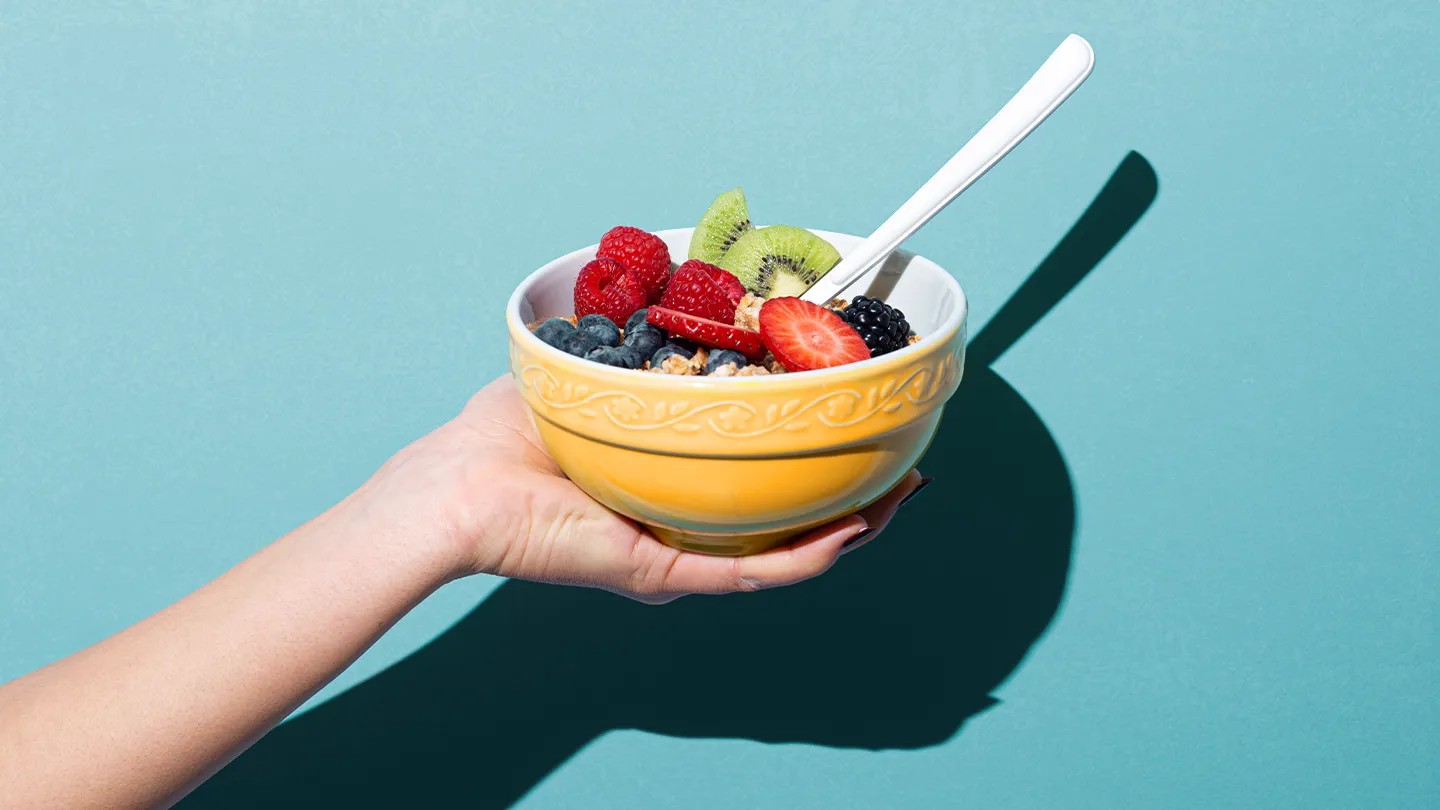
Fresh fruit. Frozen unsweetened fruit. Even dried, if it is not drenched in syrup. It boosts flavor, sure. But it adds nutrients too.
Take blueberries. One cup gives you nearly 4g of fiber. You get Vitamin C (about 16% of DV) and Vitamin K (around 24% of DV).
Blueberries, strawberries, bananas, raspberries. They provide sweetness naturally. No added sugars required. If your base cereal is dry, fruit saves it.
Stop pouring until it feels right
Unless you have a scale in the kitchen, you are probably eating too much. Two cups. Three cups. The serving size for All-Bran Original is two-thirds of a cup. That is 120 calories.
Double that pour, and you are looking at 240 calories. Triple it? 360 calories. Before milk. Before fruit. Just cereal.
Doebrich says measuring portions helps track intake. It makes sticking to a diet easier because the numbers stay accurate. We pour by habit. Measure by choice.
Swap milk for yogurt
Milk is fine. Greek yogurt is better for your bowl.
It has nearly the same calcium as milk. But the protein? Triple it. One cup of plain, nonfat Greek yogurt holds 25.2g of protein and 270+ mg of calcium.
Protein keeps you full. This means you might feel satisfied with a smaller amount of food. Fewer calories consumed overall. Weight management gets easier.
Watch out for “plant-based” traps
Soaking cereal in almond milk? Think twice.
Doebrich says soy is your best plant-based bet for protein. Almond or oat milk falls short. One cup of almond milk has only 1.3g of protein.
Compare that to 8.4g in nonfat cow’s milk. Or even more in soy milk.
Also, many plant milks sneak in added sugar. Always choose the unsweetened version, insists Hultin. Otherwise, you might as well drink juice.
Add fats and crunch
Hultin tells her clients to grab an ounce of nuts. That fits in a cupped hand.
An ounce of pistachios gives you almost 3g of fiber and nearly 6g of protein. They offer polyunsaturated fats, too. These healthy fats help reduce LDL “bad” cholesterol. Which lowers heart disease and stroke risk.
Walnuts. Almonds. Hazelnuts. All good choices.
But nuts are calorie bombs. One ounce is roughly 160 to 190 calories. Do not exceed it unless you want the scale to go up.
If nuts aren’t your thing, try seeds. One ounce of chia seeds provides almost 10g of fiber. Plus nearly 5g of protein.
Flax, sunflower, hemp, pumpkin seeds. Same rule applies. One or two ounces a day max. They are dense. Energy-dense.
Do not ignore the fortified stuff
Cereals are often fortified. Manufacturers add vitamins and minerals like iron, zinc, folate, and calcium.
Doebrich says fortified cereals deliver nutrients that often go missing from daily diets. They are convenient carriers for things we might otherwise skip.
Hultin warns against excess, though. Some cereals are heavily fortified. It helps to know what your body actually needs. A dietitian can tell you which gaps to fill. Take too much of one thing and the balance breaks.
Sources
- Sugar. American Heart Association, June 2024
- Zhao S et al., JAMA Network Open, May 2025
- Get to Know Grains. American Heart Association, June 24, 2020
- Shivakoti R et al., JAMA Open Network, March 2022
- Nutrition Facts Label. US Food and Drug Administration, March 2024
- Kellogg’s Honey Smacks. WK Kellogg Co
- How to Reduce Added Sugar. AAP, Aug 2024
- Blueberries. US Dept of Agriculture, Oct 2022
- Kellogg’s All-Bran. WK Kellogg Co
- Yogurt. US Dept of Agriculture, October 2022
- Protein. Cleveland Clinic, October 22, 2009
- Almond Milk. US Dept of Agriculture
- Milk. US Dept of Agriculture
- Pistachio Nuts. US Dept of Agriculture
- Fats in Foods. AHA, January 09, 26 (Note: Original source date future-dated or typo in provided text)
- Gordon B, Academy of Nutrition and Dietetics
- Seeds, Chia. USDA, April 1, 19 (Typo in year? Text says 2019)
- Quick-Start Guide. Harvard Health Publishing
- Food Fortification. WHO
- Garg M et al., Frontiers in Nutrition
The People Behind The Words
Jennifer Frediani, PhD, reviewed the science. Lauren Bedosky wrote it. Both have degrees. They know food. Listen to them, maybe. The box won’t lie to you, the marketing on the front will.


