







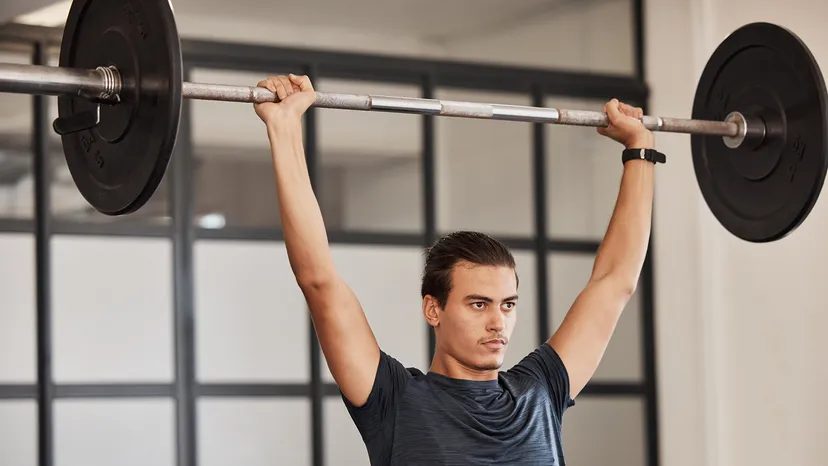
The overhead press sounds deceptively simple. Pick up a weight. Push it above your head. Repeat. But anyone who has tried it knows this move is a complex physics lesson disguised as a basic lift. It engages the shoulders, triceps, core, shoulder blades, wrists, and even your feet.
Do it right, and you build upper body strength, support long-term shoulder health, and master a fundamental movement pattern. But it rewards patience. The lifters who press the most weight aren’t necessarily the strongest; they are the ones who respect proper form before asking, “How much more can I add?”
What the Overhead Press Actually Targets
This is a compound exercise. It trains multiple joints and muscle groups simultaneously. The primary movers are the deltoids, specifically the anterior (front) and medial (side) heads. Your triceps assist in the final lockout. Meanwhile, your upper chest, upper back, abs, and smaller stabilizers work overtime to keep your body from wobbling like a cheap folding chair.
The shoulder joint is designed for mobility, not brute-force stability. This is where the rotator cuff becomes critical. These muscles hold the upper arm bone securely in the socket, which is essential whenever you are pressing weight directly overhead.
Think of your shoulder blades as the platform for a crane. If that platform shifts unexpectedly, the crane struggles to lift. Strong scapular stabilizers create a solid base, allowing your shoulders to work efficiently in a straight vertical line.
Beyond strength, this lift may support muscle growth and bone density. By loading the upper body through a demanding range of motion, it stimulates adaptation. Like other compound movements, it helps build mass when paired with sufficient volume, recovery, and nutrition.
Setting Up for a Safe Overhead Press
Proper technique starts before you even touch the bar.
Set the barbell in a squat rack or power rack at roughly shoulder height. Grip the bar firmly with your thumbs wrapped around it. A thumbless grip is risky and reduces stability. Rest the bar near the heel of your palm, not deep in your fingers. This keeps your wrists straight. If the bar sits too high, your wrists will bend backward, weakening the structure.
Step into the bar with it resting on the front of your shoulders. Your elbows should sit directly below the bar, not tucked behind it. This alignment keeps your forearms vertical, creating a stronger path for the bar and giving you a better chance to press it straight up.
Before the lift begins, brace your core. Squeeze your glutes. Keep your ribs down; do not let them flare. A slight lean back at the bottom can help the bar clear your face, but avoid turning the movement into a standing bench press by arching your lower back excessively.
Move your head just enough to clear the bar. Once the weight is overhead, move your head through so the bar finishes directly over your mid-foot. At the top, lock your elbows. Do not shrug your shoulders into an awkward position. In the final position, your bar, shoulders, hips, and mid-foot should align. This allows your skeleton to support the load rather than forcing your muscles to fight for control.
Common Mistakes That Ruin the Lift
Many lifters make errors that make the press harder and riskier.
One classic error is the J-curve. The bar drifts forward around the face, then swings back over the head. This longer route increases the range of motion and wastes energy. A clean bar path travels close to a straight vertical line, minimizing the distance the weight must travel.
Another issue arises when lifters start with their elbows behind the bar. This tilts the forearms, bends the wrists, and saps power before the movement even begins. Keep wrists straight, forearms vertical, and the bar close to your body.
Bending your knees changes the exercise entirely. If you dip your knees or drive your hips forward, you are no longer doing a strict press. You are moving into a push press. While push presses are useful for developing power and are a valid variation, they are not the same test of raw shoulder strength. In a strict press or military press, the legs stay quiet. The shoulders do all the work.
Skipping the lockout is also dangerous. If your elbows stay soft at the top, the bar may drift, forcing you to keep fighting the load with fatigued muscles. That is a precarious place to lose control.
Wrist pain often comes from letting the bar sit too high in the fingers. Shoulder pain can stem from poor mobility, excessive weight, or forcing the joint into a position it cannot stabilize.
If pain changes your normal range of motion, stop heavy overhead activity immediately. The Mayo Clinic advises avoiding painful lifting or overhead activity if you suspect rotator cuff pain. Get qualified guidance before pushing through discomfort.
The overhead press demands respect. It is not just about moving weight. It is about moving it efficiently, safely, and with control. Ignore the details, and the lift will eventually demand payment. Respect them, and the strength follows.
Why Shoulder Press Variations Matter
The standard standing overhead press is the go-to for most lifters, but it isn’t the only tool in the shed. Different variations solve specific mechanical or structural problems. If your shoulders ache or you’re hitting a plateau, switching up the variation might be the fix you need.
Take the military press. It’s stricter. You keep a narrower stance and eliminate leg drive. That removes the ability to cheat with momentum, forcing the shoulders to do the heavy lifting. It builds total-body tension because you can’t hide in the hips.
Then there’s the dumbbell overhead press. Each arm works independently. This helps balance out side-to-side strength gaps that barbells ignore. It also demands more stabilization from your core and rotator cuff. Some lifters find it easier on the joints because the dumbbells let your hands rotate naturally through the movement.
Space and ceiling height matter too. A seated press removes leg involvement entirely. This isolates the shoulders but requires strict core control to avoid arching the back. ACE Fitness notes that proper setup means sitting with support and aligning weights at shoulder height. It’s practical for low-ceiling gyms, though technique still rules.
Other options include the Arnold press and resistance bands. They change the angle of resistance slightly, targeting different parts of the deltoid. For advanced lifters, the push press adds leg drive to move heavier loads. The clean-and-press is a full-body beast, starting from the floor and finishing overhead like a front squat hybrid.
How to Improve Your Overhead Press Safely
Improving this lift isn’t about grinding out reps until you collapse. It’s about frequency and recovery. Most lifters benefit from pressing two to three times a week. Mix in lighter sessions to refine technique without wrecking your shoulders.
Start light. The overhead press looks simple but relies on timing, bracing, and mobility. If you skip the fundamentals, you risk bad habits. A certified coach can catch bar path errors, wrist misalignment, and excessive low-back arching before they become permanent.
Mobility is the hidden key. Tight lats or triceps can block a clean overhead position. Don’t yank your shoulders into place. Build controlled range so the bar travels straight and the shoulder blades rotate smoothly.
Don’t neglect the small stuff. Rotator cuff exercises, scapular stabilizers, and upper back work make the main press feel secure. Triceps strength often determines lockout success. If you stall at the top, your triceps might be the weak link.
Eccentric training helps too. Lowering the weight slowly increases time under tension. It gives supporting muscles more work to do, building resilience.
The bench press gets all the glory. But the overhead press asks a harder question: Can you create a rigid line from floor to hands without leaking force?
When you answer yes, you aren’t just bulking up your delts. You’re teaching your whole upper body to work as one unit. The synergy required here is rare in other lifts. It’s satisfying when it clicks. And it rarely happens overnight.


